
Data Entry Guide for Green Deals
(Vers.4, 20 Feb 2026)
A) Documenting carbon offset projects in the LM database
1. Inclusion criteria for carbon offset deals in the LMI Database
-
Not all carbon offset projects are considered as land deals. The four criteria of the Land Matrix deal definition should be applied also to carbon offset projects.
The Land Matrix records large-scale land acquisitions / deals that:- Entail a transfer of rights to use, control, or ownership of land through sale, lease, or concession, license (…etc.);
- Have been negotiated or concluded in the year 2000 or later;
- Cover an area of 200 hectares or more;
- Imply a potential effect on smallholder livelihoods, local community use, important ecosystem service provision, or on the distribution of land (rights).
These criteria may be deviated from in individual cases of particular interest, e.g. in the case of serious land conflicts, human rights violations and/or major impacts on the local population.
-
In addition, the following points should be considered:
-
REDD+ projects that clearly meet the LM deal definition are always included if they are clearly based on single deals/projects. Jurisdictional REDD+ approaches which are spread over an entire local government area are not included.
-
Carbon offset projects in partnership with local communities where the communities retain full control over their land and the rights to their land are not included in the LM database since they do not entail a complete transfer of rights to use, control, or ownership of land (1).
-
The transfer of management in a conservation project from the state to an NGO, while the land remains state-owned, is not a land deal. Even if the new management involves accessing carbon markets and selling carbon credits to fund operations, it does not constitute a large-scale land acquisition / land deal. This is because the state still owns the land and these management shifts typically result in only marginal changes to land use rights over time, as the conservation area was already protected beforehand. Only those who monitor and, if necessary, enforce compliance with nature conservation regulations are replaced by another actor (2).
-
Reforestation projects initiated by states or NGOs often also aim to sequester carbon but fall outside the focus of the LMI if no transfer of land ownership or land use rights is involved (3).
-
Sometimes carbon offset deals are “growing” deals where the land is acquired piece by piece, hence multiple land deals (Deal #11218). These deals should be also included.
-
(1) This are two examples of project based on community land that are not included: https://www.planvivo.org/Handlers/Download.ashx?IDMF=430ec243-b1c7-439e-a626-92db8292165d // https://registry.verra.org/app/projectDetail/VCS/5107 . This is an example of a deal that is included: https://landmatrix.org/deal/9769/contracts/
(2) An example of such an arrangement from Madagascar: https://registry.verra.org/app/projectDetail/VCS/1215
(3) https://www.giz.de/en/worldwide/85060.html
2. Key sections
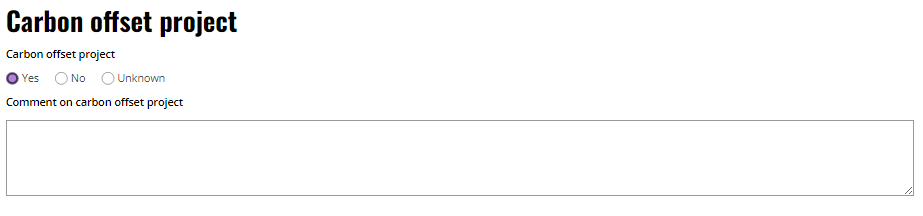
Carbon offset project:
-
Carbon offsetting refers to compensating for greenhouse gas (GHG) emissions by funding activities that either reduce emissions or remove carbon from the atmosphere elsewhere. These activities can include renewable energy projects, land restoration, or tree planting initiatives that increase carbon storage.
-
If a project sells or intends to sell carbon credits, it qualifies as carbon offsetting. Projects focused solely on environmental conservation without trading carbon credits should not be labeled as carbon offsetting. This also includes projects that claim to offset or reduce emissions but neither hold certification nor appear to be pursuing it. In some cases, such claims amount to little more than marketing rhetoric without any substantive real-world basis.
-
Clean Development Mechanism (CDM) projects should always be labeled as carbon offset projects.
-
REDD+ projects registered in the Verra registry should always be labeled as carbon offset projects. Note that not all REDD+ projects are listed in offset registries, since not all finance themselves through carbon markets.
-
Renewable energy plants are occasionally used as offsets, though this practice is becoming less common. Companies may still argue that their renewable energy projects contribute indirectly to the reduction of fossil fuels, leading some reports to refer to them as offsets. However, this does not always involve a direct offsetting mechanism. The key criterion is whether the project is registered in a carbon credit registry. Note that the CDM includes many renewable energy projects.
-
"Carbon neutral" does not necessarily imply that a project is used for carbon offsetting. Instead, it may mean that the developers aimed to offset or minimize emissions from the project's development process (e.g., construction), which is not our focus. Additionally, companies might market products as carbon-neutral if they have used carbon offsets to compensate for emissions associated with the product itself.
-
Any project intended to be a carbon offset should be marked as a carbon offset project with “Yes”.
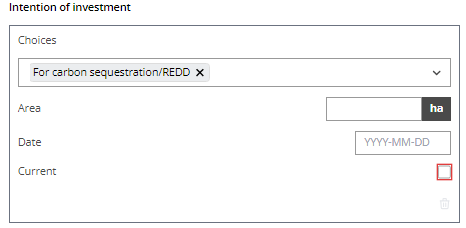
For carbon sequestration/REDD:
-
This intention encompasses all carbon offset projects that are related to forestry, but it is not limited to them. It also includes investments in forestry where the investor aims to sequester carbon without the intention of selling carbon credits.
-
REDD+ is a mechanism aimed at reducing emissions from deforestation and forest degradation while promoting conservation, sustainable management of forests, and enhancement of forest carbon stocks. REDD+ projects can generate carbon credits under certain conditions and are funded by public and private sources. However, not all REDD+ projects are using carbon markets for accessing finance. Some are financed directly through the World Bank and other donors.
-
Other investment intentions, such as 'Timber plantation for Wood and Fiber,' are also common. In some cases, REDD projects may involve the formal establishment of legal conservation areas, in which case the 'Conservation' category should be selected. However, 'Conservation' should not be selected if it is merely mentioned as objective in the project document, as conservation is already an inherent part of REDD.
Data Sources:

-
Upload only the project description document of carbon offset deals, not all documents that are listed in the registries (unless of course you found other relevant information), to ensure the relevance of uploaded data sources.
-
As the Clean Development Mechanism (CDM) is a UN mechanism, record it as a "government source."
-
While Verra is a non-profit organization, the information provided is sourced from companies verified by private certifiers. Therefore, record this as "company information."
-
When using databases such as the ID-RECCO or the Berkeley dataset, upload the relevant Excel files in the data sources (data source type = company sources).
Produce Section:
-
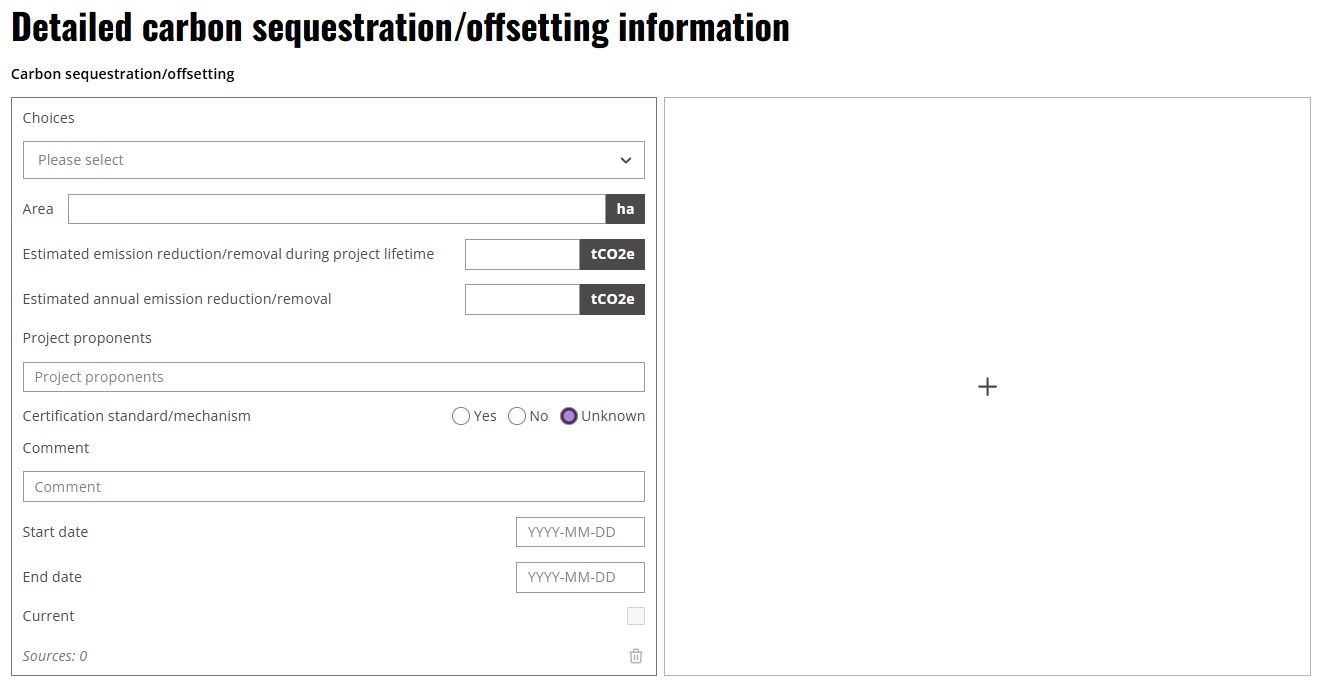
Area: This refers to the land used for carbon sequestration or the area registered under a carbon offset project. This is the area where the “production of the carbon credits” takes place. Carbon offset registries always report the project area in their project documents. Note that this area may not necessarily align with the boundaries of a concession, lease, or land purchase. If the land deals have more than one production model (including for example also crop production), the area under the carbon sequestration/offsetting will be different from “size in operation” in the general section.
-
Project proponent: In the context of carbon offset deals, "project proponents" and "implementing companies" refer to different roles within the project's lifecycle. Project proponents are the entities or organizations that initiate, design, and promote the carbon offset project. They are responsible for the project's overall concept, securing funding, and ensuring that it aligns with regulatory and certification standards. Implementing companies are the entities or contractors responsible for executing the project on the ground. They manage the practical aspects of project implementation, such as protecting the forest or maintenance. Implementing company details are added on the investor tab as per normal editor guidelines rules
-
Certification standard / mechanism: If the status of a carbon offset project in a registry is listed as "under development," or “under validation” etc. please also select "yes" for the certification standard and select the status “applied”. The same applies for projects that are on hold, cancelled, or expired, please select the appropriate label under the header “Status”. “Name” refers to the name of the carbon standard. Note that REDD+ projects are typically certified under the Verified Carbon Standard (VCS), so you should enter both "REDD" and "VCS." ( Deal #10588 (landmatrix.org). The Climate, Community & Biodiversity (CCB) Standard, which focuses on land-based carbon projects and their socioeconomic impacts is often combined with the VCS. “ID” refers to the project ID within the respective registry.
-
Start date: The first year when reductions/removals occurred (as claimed). The crediting period and first monitoring period of a project will commence on the project’s “start date”. The start date can also be set before the registration of the project (crediting is done retrospectively in some projects). Note that the start date does not necessarily correspond to the year the lease/concession was signed.
-
End date: The year when the certified reductions/removals stopped (as claimed). This is the end of the crediting period.
-
Please note that any major changes in this section—such as modifications to the project area or its proponents—can be documented in a new tab and subsequently marked as the current version. Changes in the status of the certification standard do not need to be recorded in a separate tab.
3. Relevant databases
Aside from offset registries the following database can be relevant to retrieve data for the LMI database:
Berkeley Voluntary Registry Offsets Database:
|
Berkeley database |
LMI variables |
|
Project Site Location |
Location |
|
Voluntrary registry |
Certification standard/mechanism in produce section |
|
Estimated Annual Emission Reductions |
Projected annual carbon sequestration in produce section |
|
First Year of Project (The first year when reductions/removals occurred (as claimed)) |
Start Date in produce section |
|
Type |
Choices in produce section |
|
Voluntary Status |
Comment section: If voluntary status is under development etc. please click the respective and leave a comment that e.g. „VCS certification is under development“in produce section |
|
Project Developer |
Operating/Parent Company (in some cases) |
|
First Year of Project |
Size in operation (year) |
|
Project Name |
Name of investment project |
|
Project ID |
ID of certification standard/mechanism |
ID-RECCO:
International Database on REDD+ Projects and Programs - Idrecco (reddprojectsdatabase.org)
|
ID-RECCO database |
LMI |
|
location_details & Longitude & Latitude |
Location |
|
project_name |
Name of investment project |
|
area |
Contract size of deal (depends on implementation status) |
|
starting_year |
Size in operation (year) |
|
monetary_benefit_detail & non_cash_benefits_describe & education_describe & infrastructure_describe & wellbeing_describe |
Promised / Materialized benefits for local communities |
|
employment_amount |
Number of total jobs created |
|
source_2022 & source_2020 |
Data sources |
|
contested |
Presence of land conflicts |
|
FPIC |
Community consultation |
|
project_type & precision_ar_type |
Choices in produce section |
|
standard_1 & standard_2 & standard_3 |
Certification standard/mechanism in produce section |
B) Documenting renewable energy projects in the LM database
1. Inclusion criteria for renewable energy deals in the LMI Database
-
The four criteria of the Land Matrix deal definition must be applied also to renewable energy deals:
The Land Matrix records large-scale land acquisitions / deals that:-
Entail a transfer of rights to use, control, or ownership of land through sale, lease, or concession, license (…);
-
Have been negotiated or concluded in the year 2000 or later;
-
Cover an area of 200 hectares or more; Deals with more than 200 hectares are included, but in case of major impacts for the local population, deals with 50ha or more can also be included.
-
Imply a potential effect on smallholder livelihoods, local community use, important ecosystem service provision, or on the distribution of land (rights).
-
These criteria may be deviated from in individual cases of particular interest, e.g. in the case of serious land conflicts, human rights violations and/or major impacts on the local population.
-
In addition, the following points should be considered:
-
We cover only solar park and wind farm deals systematically.
We include solar and wind projects, regardless of whether they qualify as carbon offsets (see section on carbon offsets for more information). -
We do not systematically cover
-
Offshore windfarms
-
Floating photovoltaics (FPV)
-
Hydropower plants.
-
-
2. Key sections
Land area:
-
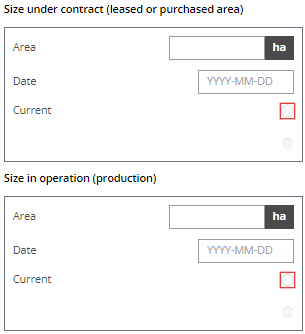
Size under contract: The contract area, which is the total leased or purchased area, should be captured in the General Info Section under size under contract. In case of large solar parks or wind farms, document the solar park or larger management units, and include the names of individual companies that manage smaller section of the park in the comments section and as “actors involved in the negotiation / admission process” ( Deal #7531 (landmatrix.org). As with industrial parks, a government agency usually oversees the land, so ensure this is accurately reflected in the recording.
-
Size in operation: For Windmills: For fully functional wind parks, the operational area equals the contract area. If only part of the wind park is operational, note the proportion (e.g., 1000 ha size under contract but only 50% of the park operational should be recorded as 500 ha for size in operation). Mandatory conservation areas are exceptions and should be deducted from production area (e.g., 1000 ha size under contract and 100 ha are set aside for conservation, then the size in operation should be 900ha if the park is fully operational). For solar parks, the size in operation equals the area covered by solar panels and related facilities if known or the size under contract if the solar park is fully operational.
Produce Section:
-
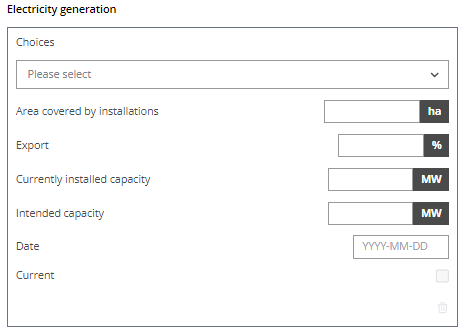
Choice: The choice “Solar (Thermal System)” can be defined as follows: Unlike “Solar (photovoltaic)” where sunlight is directly converted into electricity, solar thermal systems convert sunlight into heat. They use mirrors or lenses to concentrate sunlight onto a receiver, which in turn heats a water reservoir.
-
Area covered by installations: Record the area covered by installations (e.g., area covered by solar panels, windmills). If exact figures for the area of installation are unavailable, do not speculate; leave the field empty. Note that this area can be similar to the size in operation for solar parks, but is different for wind parks (see size in operation above).
-
Currently installed capacity: If a solar or wind project is put on hold after being operational, do not change the “currently installed capacity” data, as the installed capacity has not changed. Use the implementation status “On hold” (Suspended) for these cases.
-
Intended capacity: If the power plant is fully operational and no further expansion is planned, the currently installed capacity is the same as the intended capacity.
-
Date: When recording dates in the electricity generation section, the date should refer to the date of currently installed capacity.
Local communities / indigenous peoples:
-
Impacts on local communities, such as restrictions on settlement near windmills, should be recorded under negative impacts for local communities, even if these areas are outside the contract area.
No comments to display
No comments to display